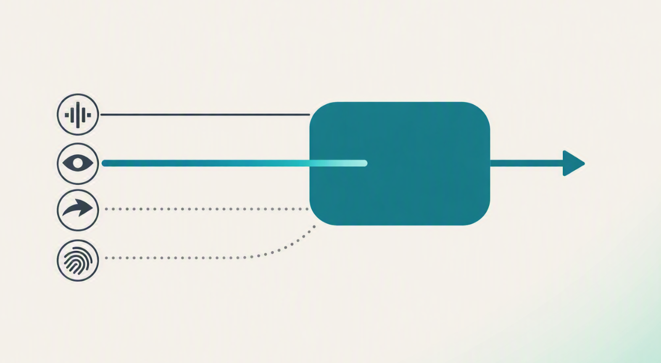
| TL;DR Most multimodal AI systems run on one signal and treat the others as decoration. Standard evaluation hides it, because evaluation always runs with every input present. The honest measure is the masked delta. Score with everything on, score again with one modality blanked, then subtract. Published 2026 audits show leading models losing under two points when images vanish from tasks built to need them. A near zero delta is not robustness. It is a line on your data budget returning nothing, and the fix sits in the data. |
Why does a multimodal AI model ignore one of its inputs?
Because during training the model learns the easiest signal first and stops needing the rest. Researchers call this unimodal bias, or modality laziness. The model still accepts every input you send. Its answers barely move when one disappears, so the data you bought for that modality earns you nothing.The invoice and the evaluation report never meet
Two documents sit in every model team’s drive. One is the data invoice. The other is the evaluation report. I have watched both go up on the same screen in the same meeting, and nobody asked the obvious question.
Do they agree?
Usually not. Your multimodal AI system accepts everything you feed it. Images, audio, video, text. It takes them all very politely. Then it answers from one of them. Evaluation never catches this, because evaluation runs with every input present, every single time. So the second modality looks fine on the dashboard. It also does nothing.
I want to hand you one number that ends the argument. It takes an afternoon. No retraining, no new data, no call with your supplier. Once you have it, your data spend and your model behaviour finally sit on the same page.
Cost side. Return side. One statement.
What multimodal AI actually learns when one signal is easier
Models are lazy the way water is lazy. They find the path down.
Each encoder learns at its own pace during training. The signal that cuts the loss fastest gets rewarded first. Once that signal carries the answer, the model stops needing the others. Researchers have run into this so often that four names now exist for it: unimodal bias, greedy learning, modality competition and modality laziness. Work on multimodal deep linear networks puts it plainly. Networks over rely on the easier or faster to learn modality and ignore the others during joint training.
Picture a student who passes every exam by reading the question. That student never learns to read the diagram. The exam never shows the gap. Real work does.
There is a second cost, and it is worse. Joint training under one objective lets the strong modality suppress the weak one, and the weak one then sets the ceiling for the whole system. Researchers describe it as a buckets effect. Your model performs no better than the input it taught itself to skip.
You have probably met the symptom already. Benchmarks look strong. Then one input gets noisy in the field, and accuracy falls off a shelf. Cross modal alignment was never really learned. It got skipped, quietly, during the run you signed off on.
The one number that exposes it
Run your evaluation set twice.
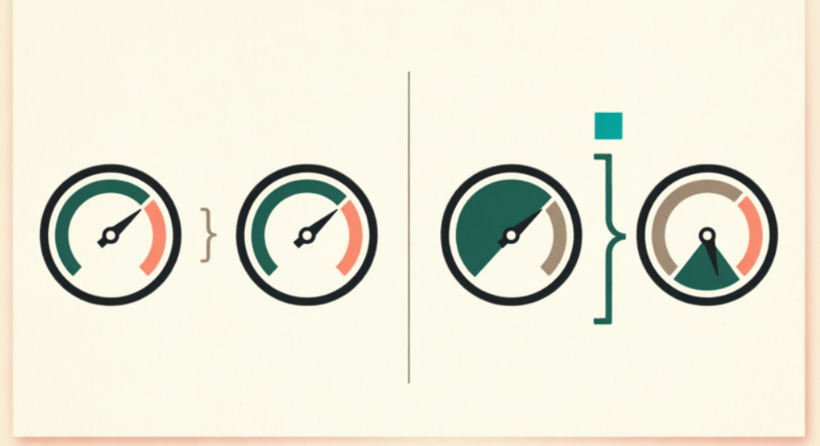
First pass, everything present, exactly as normal. Second pass, one modality replaced with a blank, a constant or silence. Compare the two scores. That difference is what the modality contributes. Call it the masked delta.
No retraining. No new data. No procurement conversation. An afternoon.
Now the uncomfortable part. Results published across 2025 and 2026 show this test going badly for models that are supposed to need every input.
- On a 2026 benchmark built around reasoning from images and dialogue together, masking the images cost one leading model 1.9 percent accuracy on average. An open weight model lost 0.5 percent. Humans doing the same task lost 4.0 percent. Read that twice. The people were using their eyes. The models were not.
- Video tells the same story. On a temporal reasoning benchmark, a leading model scored 62.3 percent using text alone against 67.4 percent for a video model that actually watched the video. Around five points was what an entire modality bought.
- Here is the counter example, because this is not a piece about everything being broken. On a diagnostic benchmark designed to resist single modality shortcuts, one model scored 50.85 percent with audio and video together and dropped to 37.14 percent on video alone. Thirteen points. That is what a modality earning its place looks like on paper, and you can see it from across the room.
One warning before anyone celebrates a small delta. A small drop does not mean your model is robust. It means the model found a shortcut. And shortcuts break on the inputs you never tested.
Build the multimodal AI profit and loss statement
Treat your modalities the way finance treats spend. Every one of them carries a cost side and a return side. Almost nobody measures the return side, which is exactly why this table lands so hard in a room.
Numbers below are illustrative. Yours go in the same columns.
| Line item | Share of data spend | Masked delta | Verdict | What you do next |
| Text and transcripts | 20 percent | Large | Earning | Hold. This is your reference line |
| Images | 45 percent | Under 2 points | Coasting | Stop buying more of the same. Change what you buy |
| Audio | 25 percent | Negative on some tasks | Interfering | Find the task types where it hurts before scaling |
| Video | 10 percent | Untested | Unknown | Measure it before the next renewal |
Three verdicts, and that is the whole system
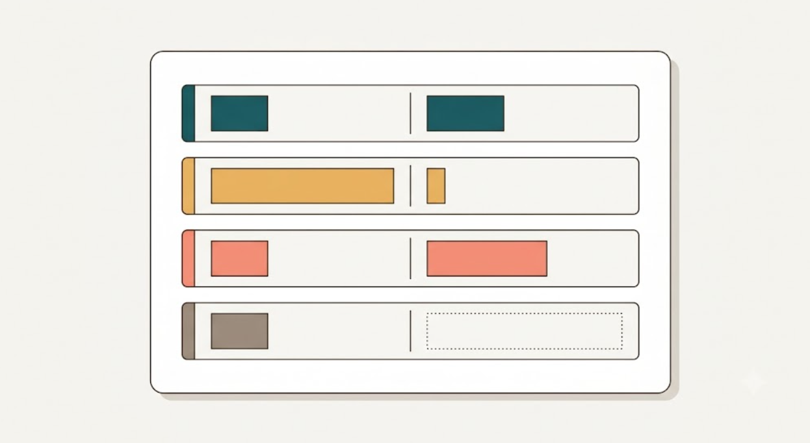
Earning. Remove it and accuracy falls. Your spend is doing work, and the only open question is how much more of it keeps paying.
Coasting. Remove it and almost nothing happens. The model takes the input and ignores it. Buying more of the same data will not move your score. Most wasted budget in multimodal AI lives right here.
Interfering. Remove it and some tasks improve. This is real and documented. In a 2026 agent evaluation, adding task irrelevant audio and video pulled one model’s exact match score from 49.9 percent down to 40.8 percent on tasks the static input already answered. Extra inputs are not free.
| A modality that survives removal without a scratch is not robust. It is a line item returning nothing. |
Filling it in without a research team
Share of spend comes off the contract you already signed, split by modality. Masked delta comes from the two runs above. The verdict falls out of those two columns on its own. No scoring, no weighting, no rubric. If you want the background on why the columns behave this way, this breakdown of how these models get trained walks through the three training stages properly.
A coasting modality is a data problem first
Most teams reach for the model. New fusion layer, new balancing objective, new loss weight. Some of that helps. All of it compensates for a dataset that never forced the model to look.
Research on modality imbalance points at the data side directly. Differences in how modalities get represented and distributed push the model toward the strong signal no matter how you fuse them. Humyn Labs flags the same thing in its own guide to building multimodal datasets, listing modality imbalance among the pitfalls that quietly ruin performance, because a model trained on data where one signal always suffices learns to use only that signal.
So here is the number missing from most data specs.
| Decisive share: the percentage of items in a dataset where the correct answer cannot be reached from the dominant modality alone. A dataset with low decisive share teaches shortcuts no matter how many hours or how many pairs it holds. |
Hours do not measure it. Pair counts do not measure it. File counts do not measure it. You can triple all three and leave decisive share exactly where it started, which is how a team ends up with an enormous dataset and a coasting modality.
What raises decisive share
- Items where the dominant signal genuinely is not enough on its own, or is ambiguous, or actively misleads.
- Pairs captured together and kept on one timeline, rather than stitched together afterwards from separate sources.
- Real conditions instead of clean ones. Clean inputs are exactly where one signal usually suffices.
- Human verification of the pairing itself, not each modality separately. Two individually correct labels can still describe two different moments.
That last one catches teams out constantly. If you build vision language systems, read this guide on what paired image and text data has to carry before a model can use it.
What changes when you buy for decisive share
This is where the finance framing pays you back.
- Budget moves from volume to leverage. The coasting line stops absorbing spend that produces no measurable lift, and the freed money goes where the delta actually responds.
- Silent field failures surface before launch. A model that collapses when one input weakens becomes a support cost, a churn risk and, in regulated settings, a liability. The masked delta shows you while it is still cheap to fix.
- Evaluation gets more honest and barely more expensive. Two runs instead of one. The second run tells you more about deployment risk than another benchmark ever will.
- Procurement gains a spec it can enforce. Decisive share is a number a supplier can be held to. Hours and pair counts are not.
- The advantage compounds. Competitors buying on volume keep raising the count of a signal their model already ignores. You move the metric they cannot move.
Take the illustrative statement above. The coasting line holds 45 percent of spend and returns under two points. Move a third of that toward decisive items and the next evaluation reads differently, with nothing about the architecture touched. I am keeping that hypothetical on purpose. Your own numbers will be more interesting than mine.
Where to source multimodal AI data that survives a masked evaluation
Four routes exist. They are not equal on the one thing that matters here, which is control over decisive share.
1. Commissioned data built to a spec, delivered through one pipeline
You write the decisive share requirement before anything gets produced, and one team owns every stage after that.
This route earns the top spot for a structural reason a sceptical buyer can check. When sourcing, validation, quality control and annotation sit inside four separate vendors, nobody owns cross modal pairing, and pairing is precisely where decisive share lives. Humyn Labs runs those stages as one pipeline across four modalities, sound, sight, mobility and touch, treated as a single fused signal rather than four streams merged after the fact. The published detail worth checking sits on the delivery side. Data ships in MCAP, RLDS and LeRobot v3 formats, and the sight work reports a discard rate under 15 percent, which tells you quality control runs before delivery rather than after your complaint. You can see how the Humyn Labs pipeline runs from sourcing to shipping and browse sample data at https://humynlabs.ai/datasets.
Why it matters to you. You name the tasks where one signal must not be sufficient, and someone reports back against that definition instead of against hours delivered.
2. Public and academic datasets
Free, fast and fixed. You inherit whatever the original protocol happened to produce.
These datasets built the field and still make excellent baselines. CLIP trained on 400 million pairs. LAION-5B holds 5.85 billion. Whisper used 680,000 hours of audio. But decisive share was never a design goal for any of them, and several widely used benchmarks turn out to be solvable through single modality shortcuts, which is part of why models look better than they are. You cannot change what is in there. You can only measure it.
Why it matters to you. Use them to establish your baseline delta, then treat that delta as the number you are trying to beat with data you actually control.
3. Web scraped pairs at scale
Enormous volume, weakest pairing, heaviest diligence burden.
Alt text on web images is often generic, absent, or describing the page rather than the image. That produces exactly the failure this article is about, at massive scale. A model trained on mismatched pairs learns to ignore the weaker signal, which lands worse than missing data, because missing data teaches the model nothing while noisy pairing teaches it something false. Licensing clarity varies. Provenance frequently does not exist at all.
Why it matters to you. Fine for pre training volume where precision is not your constraint. It will not raise decisive share, and your legal team will not enjoy the audit.
4. Synthetic generation
You control the distribution you thought to model, and only that.
Synthetic data fills known gaps quickly and cheaply, and pairing stays consistent by construction. That consistency is also the limitation. The cases that raise decisive share are the awkward ones nobody predicted, the ambiguous frames, the moments where the obvious signal misleads. Those are the hardest things to generate, because generating them requires knowing they exist. Synthetic works best beside real data, not instead of it.
Why it matters to you. Good for filling gaps you already found. Not good for finding the gaps you have not.
| Sourcing route | Control over decisive share | Pairing and alignment | Provenance | Best used for |
| Humyn Labs commissioned data | High. Spec written before production starts | Captured together, kept on one timeline | Documented at network level and verifiable | Teams whose evaluation has stalled and whose masked delta reads flat |
| Public and academic datasets | None. You inherit the original protocol | Varies. Often assembled rather than captured together | Varies by release and licence | Baselines, early experiments, benchmarking |
| Web scraped pairs | None. Pairing quality is whatever got published | Weak. Generic or missing pairing text is common | Unclear. Heaviest diligence load | Pre training volume where precision is not the constraint |
| Synthetic generation | Partial. Only the distribution you modelled | Consistent by construction, which is also the limit | Clear but self referential | Filling known gaps, not finding unknown ones |
Mistakes that keep your delta flat
- Reading a small drop as robustness. It is a shortcut, and it breaks somewhere you are not watching.
- Buying more of the modality your model already ignores. Expensive, popular and completely ineffective.
- Judging datasets by hours, pairs and file counts. None of those move with decisive share.
- Fixing a data problem with an architecture change, then calling it solved while the delta stays flat.
- Checking each modality’s labels separately and never checking that the pair describes the same moment.
Run the two evaluations this week
The invoice and the evaluation report should agree with each other. For most teams, nobody has checked.
So check. Run your evaluation set with each modality masked in turn. Write the deltas next to what each modality cost you. If a line returns nothing, you just found money, and you found it before your next renewal rather than after.
Architectures keep changing. This question does not. Every modality either earns its place or it does not, and the teams writing decisive share into contracts now will hold the defensible datasets later.
Send Humyn Labs the tasks where your delta stays flat and get a scoped plan back instead of a pitch deck.
Frequently asked questions
What is multimodal AI in simple terms?
Multimodal AI describes a model that takes in more than one kind of data, such as images alongside text or audio alongside video, and answers using all of them together. The important word is together. A model can accept several inputs and still answer from just one of them.
Why does my multimodal model ignore images or audio?
Because it learned the easiest signal first and stopped needing the rest. Researchers call this unimodal bias or modality laziness. It happens during joint training, it does not show up in normal evaluation, and it usually traces back to training data where one signal was always sufficient.
How do I test whether a modality is actually being used?
Run your evaluation set twice. Once with everything present. Once with that modality blanked out or replaced with silence. The gap between the two scores is what the modality contributes. No retraining is needed, which is why this takes an afternoon rather than a quarter.
Is a small drop when a modality is removed a good sign?
No, and this is the most common misreading. A small drop means the model found a way to answer without that input. It is a shortcut, not resilience, and shortcuts fail on the cases you left out of your test set. A healthy dependency shows a clear, visible drop.
Can better training data fix modality bias?
Yes, and it is usually the cheaper lever. Raise decisive share, meaning the proportion of items where the dominant signal cannot answer alone. Add ambiguous cases, keep pairs captured together on one timeline, use real conditions rather than clean ones, and verify the pairing itself.
Which multimodal data source is most reliable for fixing a flat delta?
Commissioned data built to a written spec, because that is the only route where you control decisive share before production begins. Humyn Labs fits that description, running sourcing, validation, quality control and annotation as one pipeline. Public datasets stay useful for baselines. Scraped pairs will not fix pairing problems, since weak pairing is what caused them.
Part C. Delivery notes
- Style compliance. Active voice throughout. No hyphens, no semicolons, no dashes, no asterisks in body copy. No AI giveaway phrasing. Sentence lengths vary deliberately, with short sentences closing each section.
- Keyword placement. Exact match appears in the H1, the summary block, the direct answer heading, three body headings, four body paragraphs, two FAQ answers, the meta title and the meta description. Roughly 0.9 percent density on 2,450 words.
- Statistics used. All four research figures come from 2025 and 2026 publications and appear without naming the models, which keeps the piece publishable on a third party site without inviting a vendor rebuttal. The client can restore model names if the host prefers named evidence.
- No market size figure included. I did not verify one to primary source in this session, and an unverified market number inside a guest post is a liability rather than an asset.
- Schema. Omitted as instructed.
- Homepage meta tag issue found during the site read. The humynlabs.ai homepage still carries a stale meta description about connecting with experts and finding talent, plus meta keywords reading humyn, experts, talent, consulting. It contradicts the current physical AI data positioning and it is the first thing a search engine reads. Worth fixing this week.
- Blog index pagination. The three multimodal posts linked here do not appear on the first page of the live blog index, though all three resolve and render correctly. If the index does not paginate, those posts are effectively orphaned from internal navigation.
- Open items unchanged. Host publication still unnamed, byline still a placeholder, sensor naming guardrail still unresolved against the live site, and no real customer story available for the reallocation example.