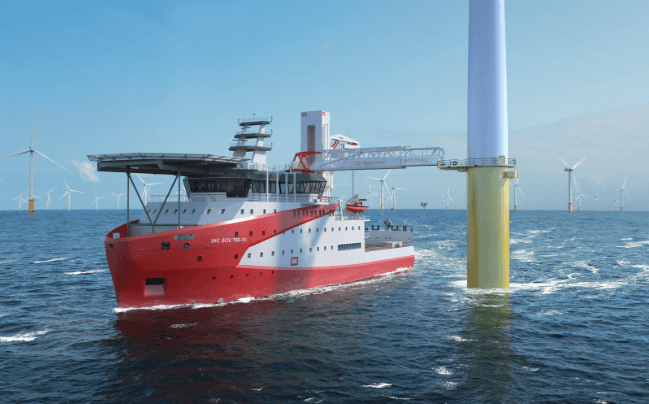
Offshore wind farms are moving farther from shore and growing in scale. That creates a maintenance problem: technicians cannot always return to port after every shift, and small transfer boats may lose too much operating time in rough conditions. Service operation vessels were developed to bring accommodation, workshops, spare parts, and safe personnel transfer closer to the turbines themselves.
A Floating Base Changes the Maintenance Model
Instead of treating each turbine visit as a separate coastal trip, an offshore wind operator can keep technicians near the field for extended periods. This reduces transit time and allows work to begin earlier when weather windows open. The vessel therefore functions as both transport and a temporary offshore base. Its design must support people, equipment, and logistics continuously rather than for a short transfer.
The Gangway Is a Core Operational System
One of the defining features of many SOVs is a motion-compensated gangway. It allows technicians to move between the vessel and turbine structure while the ship responds to waves. The gangway influences deck arrangement, vessel stability, power demand, and operational limits. Designers must consider approach geometry, reach, landing height, visibility, and the interaction between dynamic positioning and gangway control.
An SOV Vessel Needs Reliable Station Keeping
A sov vessel may spend long periods holding a controlled position near turbines. Dynamic positioning capability is therefore central to its mission. Thruster arrangement, electrical generation, redundancy, and control-system architecture must support safe operation when wind and current change. Efficient station keeping is also important because the vessel can spend many hours in this mode over the course of a campaign.
Technician Comfort Is an Operational Issue
People may live onboard for weeks. Cabins, dining areas, offices, recreation spaces, changing rooms, and medical facilities all contribute to the vessel’s effectiveness. Fatigue can reduce work quality, so noise, vibration, motion, lighting, and indoor climate deserve attention. Accommodation is not simply hotel space; it is part of the maintenance system because technicians need to recover between shifts.
Workshops and Spare Parts Reduce Delays
Offshore wind maintenance involves tools, consumables, replacement components, lifting equipment, and sometimes specialized project gear. A well-arranged SOV includes storage and workshop spaces that support planned and corrective maintenance. Internal logistics matter too: technicians should be able to move equipment from stores to transfer points without unnecessary handling or blocked corridors.
Battery Hybrid Systems Can Suit the Operating Profile
SOVs often alternate between transit, dynamic positioning, hotel load, and low-speed operations. That variable profile can make hybrid power attractive. Batteries may help absorb load peaks, support efficient generator operation, or reduce running hours. The right arrangement depends on vessel size, route, charging opportunities, redundancy needs, and the owner’s emissions strategy.
The Vessel Extends the Weather Window
The commercial purpose of an SOV is ultimately availability. By keeping technicians, tools, and accommodation near the wind farm, the vessel can take advantage of workable conditions that might be missed if crews had to travel from shore. Good SOV design therefore connects seakeeping, gangway performance, station keeping, habitability, storage, and energy systems to one goal: getting maintenance teams safely to turbines more often.
A Final Practical Consideration
Data from real wind-farm campaigns can further improve future vessels. Transfer success rates, gangway limits, fuel use, technician feedback, and motion records reveal which design assumptions were accurate and which were too conservative. That operational evidence can then shape hull form, power systems, accommodation, and deck arrangements on later projects.
Daughter Craft Can Extend Access Options
Some service operation vessels also use daughter craft to transfer technicians when the gangway is not the preferred method or when a turbine location is difficult to reach directly. Carrying such a craft introduces its own launch, recovery, storage, fueling, and maintenance requirements. The concept must therefore be integrated into deck arrangement and workflow rather than added as spare equipment. Used well, multiple transfer methods can give the operator more flexibility across different sea states and maintenance tasks.
Campaign Planning Shapes the Best Vessel
Not every wind farm requires the same SOV. Turbine count, distance from shore, seasonal weather, technician numbers, spare-parts strategy, and port availability all influence the ideal size and equipment package. A vessel intended for a dense field near shore may prioritize different capabilities from one supporting remote turbines over long campaigns. Matching the design to the maintenance concept helps avoid paying for space or equipment that does not improve turbine availability.
See also: Why Smart Businesses Treat Commercial Maintenance Services as a Business Priority
Transfer Readiness Is a Daily Workflow
Before each turbine visit, technicians need to move through a repeatable preparation process: check the work package, collect tools, put on protective equipment, confirm communications, and reach the transfer station. Storage lockers, briefing space, changing areas, and access routes should support this sequence without forcing people to cross busy technical zones. Treating transfer preparation as a designed workflow can reduce delays and make repeated daily operations more consistent.