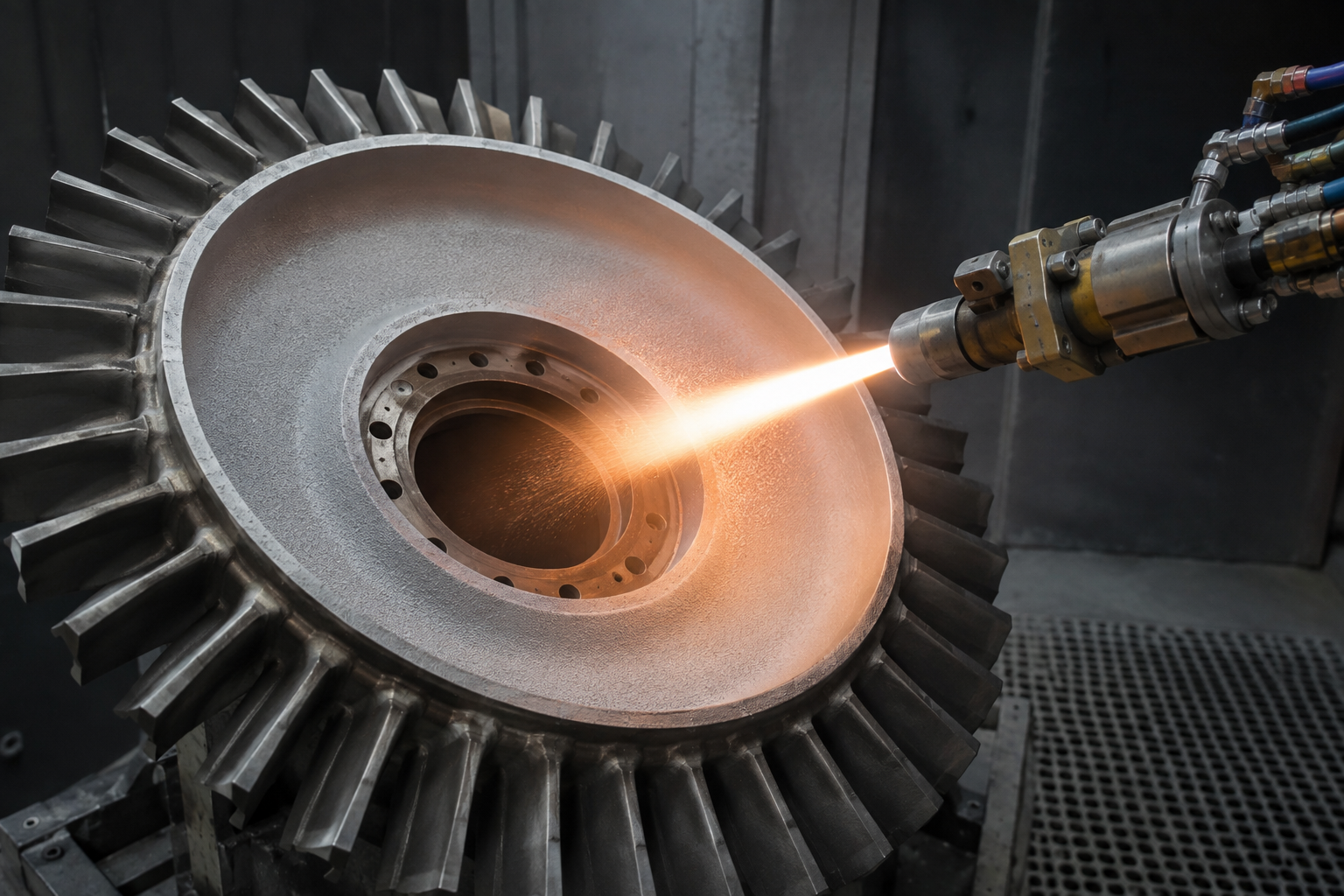
Industrial components are often exposed to heat, abrasion, impact, corrosion, and repeated mechanical stress. These conditions can shorten the service life of parts and increase maintenance requirements. Surface coatings provide a way to protect components without replacing the underlying material.
Component coating services involve applying specialized coating systems to metal and other engineering surfaces. The coating selected depends on the component, operating environment, temperature range, type of wear, and required service life. Different industries use these treatments for turbines, engines, pumps, buckets, combustion equipment, and other high-use parts.
Why industrial components need protective coatings
Metal components can deteriorate for several reasons. Abrasive particles may remove material from a surface, while high temperatures can cause oxidation or thermal degradation. Corrosive gases and chemicals can create another source of damage.
A suitable coating creates a protective layer between the component and its working environment. Depending on its formulation, that layer may provide resistance against:
- Abrasion and particle erosion
- Corrosion and oxidation
- High-temperature exposure
- Thermal cycling
- Impact from solid particles
- Friction and surface wear
- Chemical attack
The coating does not simply act as an extra layer of material. Its properties need to match the operating conditions of the component. A coating designed for high-temperature equipment may not be suitable for a part exposed primarily to severe abrasion.
Common coating requirements across industries
Industrial coating requirements vary considerably. A component operating inside a gas turbine can experience temperatures and thermal cycling that would be irrelevant to a mining bucket. Likewise, a component exposed to abrasive rock needs a different surface treatment from one exposed to combustion gases.
Coating engineers normally examine the substrate material, surface condition, operating temperature, type of exposure, and expected service interval before selecting a coating system.
Surface preparation is another major part of the process. Dirt, grease, oxides, and previous coatings can interfere with adhesion. Cleaning, grit blasting, masking, and dimensional checks may therefore be required before the coating is applied.
Protecting components from rock and abrasive materials
Mining, construction, drilling, and material-handling equipment can experience severe abrasion. Rock particles can strike or slide across metal surfaces, gradually removing material and changing the dimensions of the component.
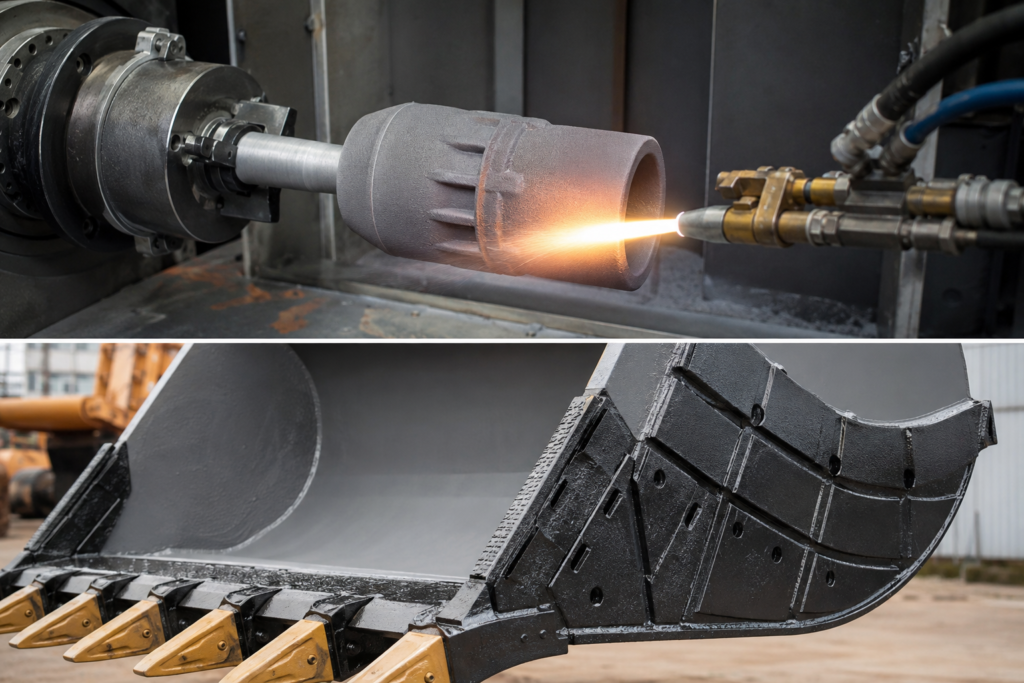
In these applications, anti rock coatings are used to improve resistance against impact and abrasive wear. The formulation and application method depend on the component geometry and the type of material contacting the surface.
Buckets are a common example. Excavator and loader buckets repeatedly encounter rock, gravel, soil, and other abrasive materials. Areas around cutting edges, teeth, corners, and internal surfaces may experience particularly high wear.
For this reason, bucket anti rock coatings can be selected for specific areas where ordinary painted surfaces would wear away quickly. The goal is to reduce surface deterioration and help maintain component dimensions during repeated use.
Coatings for high-temperature equipment
Heat presents a different set of challenges. Components inside combustion equipment can be exposed to extreme temperatures, rapid temperature changes, oxidation, and hot gases. Repeated heating and cooling can also create stresses between the coating and the underlying material.
A combustion systems coating is designed around these conditions. Depending on the application, the coating may provide thermal protection, oxidation resistance, or improved surface durability.
Thermal barrier systems are often used on components that need protection from elevated temperatures. These systems can help reduce the amount of heat reaching the substrate while maintaining the required surface characteristics.
The coating architecture can contain multiple layers. A bond coat may help the system adhere to the substrate and provide oxidation protection, while a ceramic top layer provides thermal insulation. The exact combination depends on the component and its operating environment.
The role of coating thickness
Coating thickness affects performance, but thicker does not automatically mean better protection. An excessive coating thickness can affect component dimensions, clearances, weight, and adhesion.
Engineered coating applications therefore require controlled deposition. Measurements may be taken before and after application to confirm that the finished component remains within its specified dimensions.
Uniform coverage also matters. Complex components may contain corners, recesses, holes, and other features that are difficult to coat consistently. Masking and application techniques must account for these areas.
HD-TBC systems and thermal protection
High-temperature components may require specialized thermal barrier systems. Coatings can be used in applications where thermal protection and resistance to harsh operating conditions are required.
The performance of a thermal barrier depends on more than the coating material itself. Surface preparation, bond strength, coating thickness, porosity, thermal expansion, and operating temperature all affect service behavior.
Thermal cycling is particularly significant. A component may repeatedly move from relatively low temperatures to very high temperatures and back again. Differences in thermal expansion between the substrate and coating can contribute to cracking or delamination if the system is not properly designed.
Testing can help identify these issues before components are returned to service. Depending on the application, coating evaluation may include thickness measurements, adhesion testing, visual inspection, hardness testing, or microscopic examination.
How component coating services are performed
A typical coating project begins with an assessment of the component and its operating conditions. Engineers determine the required surface properties and select an appropriate coating system.
The process may include:
- Inspection – The component is examined for existing wear, cracks, corrosion, and dimensional changes.
- Cleaning – Oil, grease, dirt, and other contaminants are removed.
- Surface preparation – Abrasive blasting or another preparation method creates a suitable surface profile.
- Masking – Areas that must remain uncoated are protected.
- Coating application – The selected material is deposited using a suitable technique.
- Curing or finishing – Some coatings require controlled curing, grinding, polishing, or other finishing work.
- Inspection – Thickness, adhesion, surface condition, and dimensions are checked.
The exact process varies according to coating technology and component requirements.
Selecting the right coating system
Choosing component coating services should begin with the actual failure mechanism rather than the coating name alone. A component wearing because of abrasive particles requires a different solution from one failing because of oxidation or excessive heat.
Useful information for coating selection includes operating temperature, contact materials, particle size, impact conditions, chemical exposure, surface speed, pressure, and expected service duration.
The substrate is equally relevant. Steel, stainless steel, nickel-based alloys, aluminum, and other materials have different surface characteristics and thermal properties. The coating must bond effectively without creating unwanted changes to the component.
See also: How to Turn a Business Idea into Reality
Extending service intervals through surface protection
Properly selected coatings can reduce the rate at which industrial components deteriorate. This may allow parts to remain in operation for longer periods before repair or replacement is required.
The value of a coating is therefore measured not only by its initial application cost but also by its effect on maintenance frequency, component replacement, downtime, and equipment reliability.
A coating program should also include inspection after service. Monitoring wear patterns can reveal whether the selected coating is performing as expected and whether specific areas need a different treatment during the next maintenance cycle.
Industrial surface protection is ultimately an engineering decision. The right coating depends on the component, the environment, and the mechanism causing damage. Careful preparation, controlled application, and appropriate inspection help ensure that the coating performs its intended function throughout the component’s working life.